
How to Build a Community Data Profile That Wins Projects
- Gary Marx

- Jan 28
- 3 min read
To build a community data profile that wins projects, clearly define community boundaries using geographic markers. Gather accurate demographic and health data from reliable sources such as the U.S. Census Bureau. Connect insights with local leaders to identify and address key community issues. Use GIS technology to visualize data and establish an ongoing data collection framework. These steps help showcase community strengths and needs to support successful project outcomes.
Key Takeaways
Define clear community boundaries using geographic markers and document them for consistency.
Gather reliable demographic and health data using GIS experts and U.S. Census Bureau sources.
Engage local leaders and community organizations early to reflect community concerns.
Use GIS technology to visualize data and boundaries for better decision-making.
Create an ongoing data collection framework with defined roles and workflows.
Why a Community Data Profile Matters for Project Success
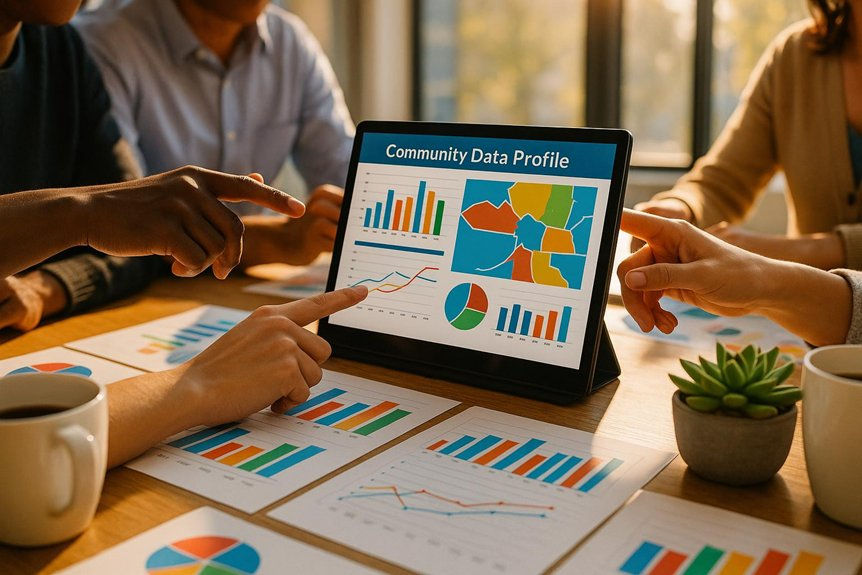
A How to Build a Community Data Profile That Wins Projects community data profile supports project success by clarifying who is affected and how. It combines demographic data, community characteristics, and information on leaders and organizations. The profile informs public health and environmental efforts by identifying social determinants of health and exposure risks. GIS tools help map boundaries and demographics accurately. A structured approach that documents boundaries, community assets, and data workflows ensures stakeholder concerns are captured and decisions are informed How to Build a Community Data Profile That Wins Projects.
Defining Your Community’s Boundaries: How to Build a Community Data Profile That Wins Projects
Community boundaries should be clearly defined using geographic areas such as neighborhoods, census tracts, or distances from a site. These boundaries must be documented in a profile worksheet to ensure consistency across data sources. Latitude and longitude coordinates support GIS layering and spatial analysis. Boundaries should be reviewed and adjusted as new information or community segments become relevant.
Gathering Accurate Demographic and Health Data
Accurate data collection relies on GIS expertise and trusted sources such as the U.S. Census Bureau, the American Community Survey, and the American Housing Survey. These sources provide data on population, housing, income, and poverty. Latitude and longitude coordinates support precise mapping. EPA ID numbers or site identifiers can link environmental and health data. A complete profile includes demographic characteristics, social determinants of health, and key community leaders.
Connecting Data Insights With Community Leaders
Data insights should be shared with state and local agencies and community organizations. Including community representatives on risk assessment teams integrates local perspectives. Engaging groups at highest risk ensures their concerns inform planning. Early involvement of community partners supports identification of loss history, high-risk groups, and local business issues. Collaboration strengthens trust and relevance of data-informed decisions.
Pinpointing Key Community Issues and Addressing Them
Key issues are identified using demographic data from public sources and engagement with local leaders. Census and housing data provide insight into housing, income, education, and poverty. Engagement helps identify environmental contamination and other concerns. Boundary and asset mapping define the community area and inventory existing resources to support engagement planning.
Using GIS Technology to Gain Valuable Insights
GIS technology integrates demographic and incident data into maps that support risk assessment and planning. Tools such as ArcGIS and Census Bureau mapping resources support demographic analysis. Collaboration with local GIS departments improves accuracy and capacity. Defining and visualizing boundaries ensures data is applied correctly and supports effective engagement strategies.
Creating a Framework for Ongoing Data Collection
An ongoing data collection framework ensures consistency and documentation. Data tasks should be integrated into daily workflows and aligned with regular reporting schedules. Roles, data destinations, review formats, and stakeholder access should be clearly defined. A data dictionary standardizes terms, sources, and field names to improve clarity and data quality.
Communicating Effectively With Stakeholders
Stakeholder communication should focus on relevance and clarity. Present actionable insights to decision-makers and detailed context to teams. Use clear definitions and a shared data dictionary. Define responsibilities for report creation, data use, and update schedules. Visuals and explanations should link metrics to community outcomes. Ongoing engagement includes feedback, documentation of actions, and regular updates.
Showcasing Your Community Profile to Drive Project Success
A strong community profile combines accurate demographic data, stakeholder identification, and a clear narrative. GIS and Census data define boundaries and ensure repeatable analysis. Highlight community leaders, organizations, assets, and resources. Use engagement plans informed by local news and social media to build trust and collaboration. Clear profiles attract support and improve project outcomes.


Comments